Why Some Men Need Lower Doses of ED Medicines
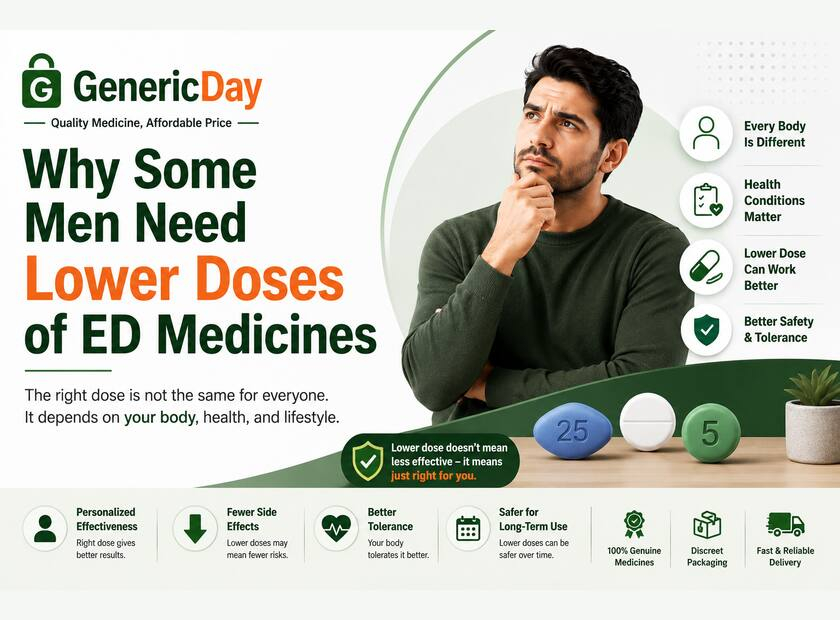
Erectile dysfunction (ED) medicines have helped millions of men improve their sexual function, but there is no universal dose that works exactly the same way for everyone. One man may respond well to a standard dose, while another may experience strong side effects from the same amount and need a lower dose.
So, why do some men need lower doses of ED medicine?
The answer is usually a combination of factors such as age, kidney and liver function, other medications, cardiovascular health, individual sensitivity, and how the body absorbs and clears the medicine. Common ED medicines including sildenafil, tadalafil, vardenafil, and avanafil belong to a group of medicines called phosphodiesterase type 5 (PDE5) inhibitors. They work by improving blood flow to the penis during sexual stimulation.
A lower dose does not necessarily mean that a man's erectile dysfunction is more severe or that the treatment will be less effective. In many situations, the goal is to find the lowest effective dose that provides an acceptable response while minimizing side effects.
This article explains the major factors that can affect ED medication dosage, when doctors may consider dose adjustments, and why patients should not change their ED medicine dose without medical guidance.
What Are ED Medicines and How Do They Work?
ED medicines are treatments used to help men who have difficulty getting or maintaining an erection firm enough for sexual activity.
Common oral ED medicines include:
These medicines are generally classified as PDE5 inhibitors. They help enhance the natural blood-flow process involved in an erection. Importantly, they do not simply create an erection automatically sexual stimulation is still necessary for these medicines to work.
The right ED medication dosage can vary considerably from one person to another. Doctors consider both efficacy and tolerability when determining whether a particular dose is appropriate.
For example, the FDA prescribing information for sildenafil says a lower starting dose should be considered in certain older adults and people with severe kidney or liver impairment because drug exposure can be higher in these groups.
That is why Erectile Dysfunction treatment is better viewed as individualized treatment, rather than a one-size-fits-all approach.
Why Do Some Men Need Lower Doses of ED Medicine?
Several factors can make a lower dose more appropriate. The most important ones include age, kidney function, liver function, other medications, cardiovascular considerations, and individual sensitivity to the medicine.
1. Age Can Affect How the Body Processes ED Medicines
Age itself does not automatically mean that a man needs a lower dose of erectile dysfunction medication. However, aging can be associated with changes in how medicines are metabolized and eliminated from the body.
For example, FDA prescribing information for sildenafil states that a starting dose of 25 mg should be considered in patients over 65 because older adults may have higher systemic exposure to sildenafil.
This does not mean every older man must take a lower dose. Rather, age can be one factor a healthcare professional considers when evaluating the safest starting dose.
Older adults may also be more likely to take several prescription medicines for conditions such as:
- High blood pressure
- Heart disease
- Enlarged prostate
- Diabetes
- High cholesterol
Because medication interactions can affect blood pressure or drug levels, the complete medication list is important when determining ED medication dosage.
2. Kidney Function Can Affect ED Drug Dosage
The kidneys help remove many substances from the body. When kidney function is significantly reduced, certain medicines or their metabolites may remain in the body for longer. This can increase exposure to some medicines and potentially increase adverse effects.
The effect depends on the specific ED medicine. For example, FDA information for sildenafil states that severe renal impairment can reduce sildenafil clearance and increase drug exposure, so a lower starting dose may be considered. This is also important when considering higher-strength sildenafil products such as Cenforce 200, as men with kidney problems should use sildenafil only under appropriate medical guidance.
Tadalafil also has specific dosing considerations for people with impaired kidney function. Its prescribing information includes restrictions and dose adjustments for certain levels of renal impairment.
Therefore, kidney disease and ED medication dosage are connected, but the exact adjustment depends on the drug and the severity of kidney impairment.
3. Liver Function Can Change Medication Levels
The liver plays an important role in metabolizing many medicines.
If liver function is impaired, the body may process some ED medicines differently. As a result, a medicine may remain in circulation longer or reach higher concentrations.
Sildenafil prescribing information states that reduced clearance can occur with hepatic impairment and recommends considering a lower starting dose.
Tadalafil also has specific considerations for hepatic impairment, including dose limitations for some patients.
This is one reason doctors may ask about:
- Liver disease
- Cirrhosis
- Abnormal liver tests
- Alcohol consumption
- Other medicines that affect liver enzymes
A person should not assume that the same ED medication dosage is appropriate regardless of liver health.
4. Other Medicines Can Require Dose Adjustments
Drug interactions are another major reason some men may need a lower dose.
PDE5 inhibitors can interact with medicines that influence blood pressure or alter how the ED medicine is metabolized.
For example, Cenforce 100, which contains sildenafil, may require careful consideration when used alongside certain medications.
One particularly important interaction involves nitrates. Nitrates are used for certain heart conditions, and combining them with PDE5 inhibitors can cause a potentially dangerous drop in blood pressure. Alpha blockers can also have additive blood-pressure-lowering effects, while some CYP3A4 inhibitors may increase the levels of certain ED medicines.
This is why a doctor or pharmacist should know about all prescription medicines, over-the-counter medicines, vitamins, supplements, and other substances being used.
5. Some Men Are Simply More Sensitive to the Medicine
People respond differently to medications.
Two men of the same age, with similar medical histories, may experience different effects from the same dose. One may get adequate erectile function with few side effects, while another may develop headaches, flushing, dizziness, nasal congestion, indigestion, or blood-pressure-related symptoms.
In such cases, a lower dose may offer a better balance between effectiveness and tolerability.
The goal isn't necessarily to take the highest possible dose. Instead, clinicians generally consider whether the treatment is providing sufficient benefit without causing unacceptable adverse effects.
Key Factors That May Influence ED Medication Dosage
| Factor | Why It Matters | Possible Clinical Consideration |
|---|---|---|
| Age | Drug clearance and exposure may change with age | A lower starting dose may be considered for some older patients |
| Kidney function | Reduced clearance can increase exposure to some medicines | Dose or dosing frequency may need adjustment |
| Liver function | Impaired metabolism can affect drug levels | A lower dose or different treatment may be appropriate |
| Other medicines | Drug interactions can increase blood-pressure effects or drug levels | Medication review may be necessary |
| Side effects | Individual sensitivity varies | Doctor may consider a lower dose or alternative treatment |
The table above illustrates general principles, the exact adjustment depends on the individual medicine and patient.
Is a Lower Dose of ED Medicine Still Effective?
Yes, a lower dose can still be effective for some men.
The effectiveness of an ED medication is not determined solely by the number of milligrams. The right dose depends on the particular drug, the person's metabolism, health conditions, other medications, and individual response.
For example, tadalafil prescribing information describes dose reduction based on individual efficacy and tolerability for its as-needed use.
This highlights an important principle: more medicine does not automatically mean better results.
If a man gets a satisfactory response from a lower dose with fewer side effects, increasing the dose may offer little additional benefit while increasing the likelihood of adverse effects.
On the other hand, if a prescribed dose does not work adequately, the appropriate response is not necessarily to take more. A healthcare professional may need to determine whether:
- The timing of the medicine is appropriate
- Sexual stimulation is adequate
- Another medication is interfering
- An underlying condition is affecting erectile function
- The dose is appropriate
- A different ED medicine may be better suited
What Happens If an ED Medication Dose Is Too High?
Taking more ED medicine than prescribed does not necessarily produce a stronger or longer-lasting erection.
Instead, higher exposure can increase the likelihood or severity of adverse effects. FDA information on sildenafil reports that adverse reactions became more frequent and more severe at higher doses in overdose studies.
Potential side effects of PDE5 inhibitors can include:
- Headache
- Flushing
- Dizziness
- Nasal congestion
- Indigestion
- Changes in blood pressure
- Visual symptoms in some circumstances
A serious but uncommon problem is priapism, an erection lasting more than four hours. NIDDK advises seeking immediate medical attention for an erection lasting longer than four hours. Sudden vision or hearing loss after oral ED medication also requires prompt medical attention.
For this reason, men should not increase their ED medication dosage on their own if the initial response seems insufficient.
Can Blood Pressure Affect ED Medication Dosage?
Yes. Blood pressure is an important consideration because PDE5 inhibitors can influence vascular tone and blood pressure.
The issue becomes especially important when a man is already taking medicines that lower blood pressure.
For example, tadalafil prescribing information warns that combining PDE5 inhibitors with alpha blockers or antihypertensive medicines can increase blood-pressure-lowering effects in some patients.
This does not mean that every man taking blood pressure medicine must avoid ED treatment. Instead, the healthcare professional needs to review the complete medication regimen and cardiovascular situation.
Men should tell their healthcare professional about:
- Blood-pressure medicines
- Alpha blockers
- Nitrates
- Heart medicines
- Other prescription medicines
- Supplements and herbal products
Why Nitrates and ED Medicines Are a Special Concern
The combination of nitrates and PDE5 inhibitors is one of the most important medication-safety issues in ED treatment.
Nitrates increase nitric oxide signaling and can lower blood pressure. PDE5 inhibitors also influence the nitric oxide/cGMP pathway. Together, these effects can cause a significant and potentially dangerous fall in blood pressure.
FDA information for sildenafil lists nitrate use as a contraindication.
NIDDK similarly warns that men taking nitrates for heart conditions should not take these oral ED medicines.
Therefore, if you use a nitrate medication, do not try to solve the problem by simply choosing a lower dose of sildenafil, tadalafil, vardenafil, or avanafil. This is a situation where medical evaluation is essential.
Do Older Men Always Need Lower Doses of ED Medicines?
No.
Being older does not automatically mean that a man needs a lower ED medication dosage.
However, age can affect drug exposure and may occur alongside other conditions or medications that influence safety.
For sildenafil, FDA labeling specifically states that a 25 mg starting dose should be considered in patients over 65 because higher plasma levels may increase adverse reactions.
The decision should therefore consider the individual's overall health rather than age alone.
A healthy older adult and an older adult with kidney disease, cardiovascular disease, or multiple interacting medicines may have very different treatment considerations.
Can Kidney or Liver Disease Affect ED Treatment?
Yes.
Kidney and liver health can influence how certain ED medicines are processed.
Kidney impairment
Severe kidney impairment can reduce clearance of sildenafil and increase exposure. Tadalafil also has specific renal dosing considerations.
Liver impairment
Hepatic impairment can also alter the metabolism of some ED medicines. Sildenafil labeling recommends considering a lower starting dose in patients with hepatic impairment. Tadalafil has separate precautions and dose limitations for hepatic impairment.
Therefore, men with known kidney or liver problems should tell their healthcare professional before starting or changing ED treatment.
How Do Doctors Decide on the Right ED Medication Dose?
Determining the right dose is usually a process rather than a single calculation.
A healthcare professional may consider:
-
The specific ED medicine being prescribed
- Age
- Kidney function
- Liver function
- Cardiovascular health
- Current blood pressure
- Other medicines
- Previous response to ED medication
- Side effects
- Other medical conditions
- Frequency and circumstances of sexual activity
Diagnosis and treatment of Impotence also involve medical and sexual history, physical examination, and sometimes laboratory or other tests. NIDDK notes that healthcare professionals review prescription and over-the-counter medicines as part of evaluating Erectile Dysfunction.
This broader assessment matters because Erectile Dysfunction can sometimes be a symptom of another health problem. Conditions affecting blood vessels, nerves, hormones, and overall health can contribute to erectile dysfunction.
Signs That Your ED Medication Dose May Need Review
A man should discuss his treatment with a healthcare professional if he experiences troublesome side effects or believes the medicine is not providing adequate benefit.
Possible reasons to request a medication review include:
- Persistent or bothersome dizziness
- Significant headaches or flushing
- Symptoms suggesting low blood pressure
- New vision or hearing problems
- An erection lasting longer than four hours
- The medicine consistently does not provide the expected response
- New kidney, liver, heart, or blood-pressure problems
- Starting another prescription medicine
Do not simply double the dose because the first dose did not work as expected.
Similarly, do not stop or reduce other prescribed medicines without speaking with the clinician who prescribed them. NIDDK advises patients to discuss medication changes with their healthcare professional rather than making changes independently.
Lifestyle Factors Can Also Affect Impotence
Medication is only one part of erectile dysfunction treatment.
Erectile Dysfunction can be associated with conditions such as diabetes, obesity, high blood pressure, cardiovascular disease, and other health problems. Lifestyle factors can also influence erectile function.
NIDDK recommends healthy lifestyle measures that may help prevent or improve Erectile Dysfunction, including:
- Quitting smoking
- Being physically active
- Maintaining a healthy weight
- Following a healthy eating pattern
- Limiting alcohol
- Avoiding recreational or illicit drugs
- Managing stress
A healthy diet may also reduce the risk of ED or improve symptoms. NIDDK notes that healthy dietary patterns, including Mediterranean-style eating, have been associated with better erectile health.
These lifestyle changes do not replace prescribed treatment for everyone, but they can form an important part of a broader erectile dysfunction management plan.
Lower Dose Does Not Mean “Weaker Treatment”
One of the biggest misconceptions about ED medicine dosage is that a higher dose is automatically better.
That is not necessarily true.
The best treatment is generally the one that provides an appropriate therapeutic response while maintaining acceptable tolerability and safety.
A lower dose may be particularly reasonable for certain patients because:
- Their body may be exposed to more of the medicine
- They may be more sensitive to blood-pressure changes
- They may take interacting medicines
- Kidney or liver function may affect drug clearance
- They may experience side effects at higher doses
- Their individual response may already be adequate at a lower dose
- The concept is similar to many other prescription medicines: the goal is appropriate dosing, not maximum dosing.
Sildenafil, Tadalafil, Vardenafil and Avanafil: Are Doses the Same?
No. Different PDE5 inhibitors have different pharmacological properties, dosing schedules, and prescribing instructions.
Sildenafil, tadalafil, vardenafil, and avanafil should not be treated as interchangeable milligram-for-milligram medicines.
Tadalafil, for example, can be prescribed for as-needed use or once-daily use, with different dosing approaches for those regimens. Its FDA prescribing information also describes adjustments based on efficacy, tolerability, kidney function, liver function, and drug interactions.
Therefore, a person should never assume that a dose of one ED medicine can simply be converted to the same number of milligrams of another.
Frequently Asked Questions
1. Why do some men need lower doses of ED medicine?
Some men may need lower doses because of age, kidney or liver impairment, medication interactions, cardiovascular considerations, or increased sensitivity to side effects. The appropriate dose depends on the specific medicine and individual circumstances.
2. Can older men take lower doses of ED medicine?
Yes. A lower starting dose may be considered for some older men. For example, FDA sildenafil labeling recommends considering a 25 mg starting dose in patients over 65 because drug exposure may be higher.
3. Does kidney disease affect ED medication dosage?
It can. Reduced kidney function may affect the clearance of certain ED medicines. The required adjustment depends on the specific drug and degree of kidney impairment.
4. Does liver disease affect ED medication dosage?
Yes. Liver impairment can change how some ED medicines are metabolized. Sildenafil labeling, for example, recommends considering a lower starting dose in patients with hepatic impairment.
5. Can other medicines require a lower ED medication dose?
Yes. Some medicines can interact with PDE5 inhibitors or increase blood-pressure-lowering effects. Alpha blockers and certain enzyme inhibitors are examples of medications that may require special consideration.
6. Is a lower dose of ED medicine still effective?
It can be. Some men achieve an adequate response with a lower dose. The objective is an appropriate balance between effectiveness and tolerability rather than automatically using the highest dose.
7. What happens if an ED medication dose is too high?
A higher dose can increase the likelihood or severity of side effects. Serious symptoms, including an erection lasting longer than four hours or sudden vision or hearing loss, require prompt medical attention.
8. Should you lower your ED medication dose if you have side effects?
Do not change the dose on your own. Tell your healthcare professional about the side effects. They can determine whether a lower dose, different medicine, or another treatment approach is appropriate.
9. Can you take ED medicine with blood-pressure medication?
Sometimes, but the combination needs to be evaluated based on the medicines involved and the individual's health. Some combinations can increase blood-pressure-lowering effects. Nitrates are a particularly important contraindication with PDE5 inhibitors.
10. What is the lowest effective dose for erectile dysfunction medicine?
There is no single lowest effective dose for every man. The appropriate dose depends on the specific ED medicine, medical conditions, other medications, and individual response. A healthcare professional can determine the appropriate dose.
When Should You Talk to a Doctor About Erectile Dysfunction Medication?
You should speak with a healthcare professional before starting, stopping, or changing an Erectile Dysfunction medication, particularly if you have cardiovascular disease, kidney disease, liver disease, low blood pressure, or take multiple medicines.
You should also seek urgent medical attention if you experience:
- An erection lasting more than four hours
- Sudden vision loss
- Sudden hearing loss
- Severe or concerning symptoms after taking the medicine
NIDDK specifically recommends prompt medical attention for prolonged erections and sudden vision or hearing loss associated with oral ED medicines.
ED itself can also be a sign of another health condition, so persistent erectile problems deserve proper evaluation rather than simply increasing medication dosage.
Conclusion
Some men need lower doses of ED medicines because age, health conditions, other medications, and individual response can affect how the medicine works. A lower dose may provide good results with fewer side effects. The right dose depends on the individual, so always follow your healthcare professional’s advice and avoid changing the dose on your own.
References