How Poor Circulation Affects ED Medication Effectiveness
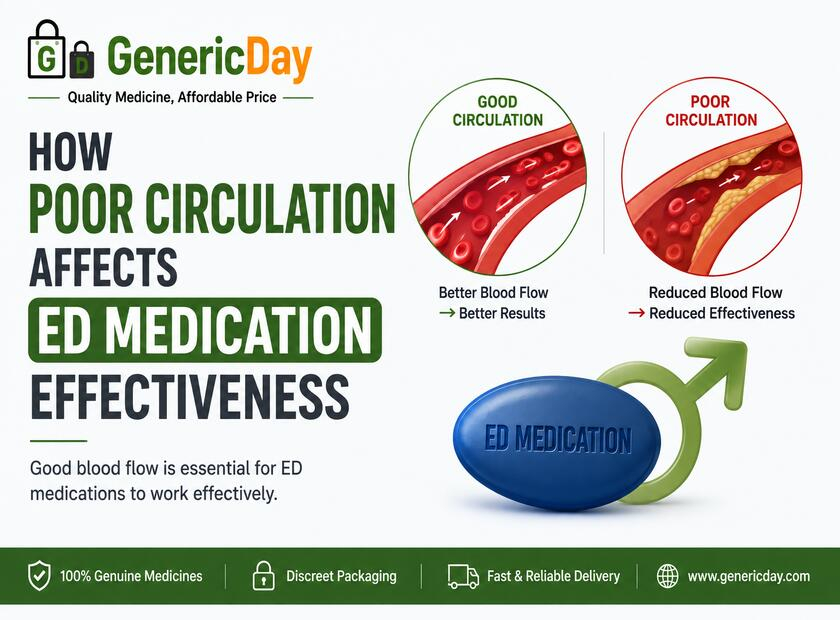
Quick Answer: Poor circulation can make ED medications like sildenafil and tadalafil less effective because erections depend on adequate blood flow to the penis. Addressing cardiovascular risk factors and underlying circulation problems may help improve treatment response.
What happens when an ED medication is working, but an underlying blood-flow problem is limiting the response? For men using erectile dysfunction (ED) medications such as sildenafil or tadalafil, poor circulation can contribute to weaker or inconsistent erections.
Sildenafil and tadalafil are PDE5 inhibitors that help improve blood flow to the penis during sexual stimulation. Sildenafil-based products, including Cenforce 200, contain sildenafil as the active ingredient. However, Impotence medication does not necessarily correct the underlying cardiovascular or circulation problems that may contribute to erectile dysfunction.
Understanding the connection between poor circulation, cardiovascular health, and Erectile Dysfunction medication effectiveness can help explain why treatment may not always produce the expected results. Lifestyle factors, diabetes, high blood pressure, smoking, obesity, and certain medications can also affect blood flow and erectile function.
What Is Poor Circulation?
Poor circulation refers to reduced or inefficient blood flow through the body's blood vessels. For erectile function, healthy circulation is particularly important because an erection requires sufficient blood to enter and remain within the erectile tissues of the penis.
Several cardiovascular and metabolic factors can affect circulation, including:
- High blood pressure
- High cholesterol
- Diabetes
- Smoking
- Obesity
- Physical inactivity
- Cardiovascular disease
- Atherosclerosis
Because erectile function depends heavily on vascular health, changes in blood vessels can contribute to ED.
How Does Poor Circulation Affect ED Medication Effectiveness?
Poor circulation may reduce the effectiveness of Impotence medications because PDE5 inhibitors depend on adequate penile blood flow to support an erection.
Sildenafil and tadalafil are examples of PDE5 inhibitors used in the treatment of erectile dysfunction. They work by helping maintain the activity of cyclic guanosine monophosphate (cGMP), which supports relaxation of smooth muscle and increased blood flow into penile tissue during sexual stimulation.
The process can be simplified as:
Sexual stimulation → nitric oxide signaling → cGMP activity → blood vessel relaxation → increased penile blood flow → erection
PDE5 inhibitors support this pathway, but they do not independently create an erection or completely overcome severe vascular impairment.
If the arteries supplying the penis are significantly narrowed or damaged, the amount of blood reaching erectile tissue may be limited. This can make the erectile response weaker even when the medication is being used appropriately.
Who Is This Information For?
This topic is especially relevant to:
| Audience | Use case | Decision context |
|---|---|---|
| Adult men with ED | Understanding weak erections | Discuss treatment options |
| Men using sildenafil | Evaluating inconsistent results | Review possible contributing factors |
| Men using tadalafil | Understanding treatment response | Discuss cardiovascular health |
| Men with vascular risk factors | Connecting circulation and ED | Consider medical evaluation |
| ED-treatment researchers/readers | Understanding PDE5 inhibitors | Compare contributing factors |
This does not mean that poor circulation is responsible for every case of Erectile Dysfunction. Erectile dysfunction can also involve psychological, neurological, hormonal, medication-related, and relationship factors.
What Products and Medications Are We Talking About?
For clarity, ED medication refers here primarily to PDE5 inhibitor medicines used for erectile dysfunction.
Common examples include:
-
Sildenafil — a PDE5 inhibitor commonly used for Impotence.
-
Tadalafil — a PDE5 inhibitor used for ED and, in different dosing approaches, certain other medical conditions.
-
Other PDE5 inhibitors — additional medicines in the same therapeutic category may also be prescribed for Impotence.
The specific medicine, strength, timing, and suitability depend on the individual and should be determined according to professional medical advice.
Brand names can vary by country and manufacturer, so the active ingredient is often the most useful way to identify the medication category.
Why Blood Flow Matters for an Erection
An erection is a coordinated process involving the brain, nerves, hormones, blood vessels, smooth muscle, and penile tissue.
During sexual stimulation, nerve signals contribute to nitric oxide release. This increases cGMP activity, helping relax smooth muscle around penile blood vessels.
More blood can then enter the erectile tissues, supporting penile rigidity.
PDE5 inhibitors help preserve cGMP activity by slowing its breakdown.
This explains an important treatment principle:
An ED medication can support the body's erection mechanism, but it still needs adequate blood flow and sexual stimulation for the process to work effectively.
Practical Example: Why the Same Medication May Not Work the Same Way
Consider this realistic hypothetical scenario.
A 55-year-old man has been using a prescribed PDE5 inhibitor for Erectile Dysfunction. Initially, he experiences satisfactory erections. Over several months, he becomes less physically active, gains weight, develops poorly controlled blood pressure, and notices that his erections are no longer as firm.
He might assume that the Erectile Dysfunction medication has simply stopped working.
However, the change in cardiovascular risk factors provides another possible explanation.
This does not prove that poor circulation is the cause. But the pattern gives the man a useful reason to discuss vascular health, blood pressure, metabolic health, and medication response with his healthcare professional.
This is an important use-case example: when erectile function changes over time, evaluating the broader health context can be more useful than focusing only on the medication.
What Can Make ED Medication Seem Less Effective?
Poor circulation is only one possible factor.
Other issues can include:
| Potential factor | Why it matters |
|---|---|
| Poor circulation | May limit penile blood flow |
| Insufficient sexual stimulation | PDE5 inhibitors do not independently create an erection |
| Anxiety or stress | Can interfere with sexual arousal |
| Excessive alcohol | May impair sexual performance |
| Certain medications | Some medicines can contribute to ED |
| Underlying disease | Diabetes and cardiovascular conditions can affect erectile function |
Therefore, one unsuccessful experience should not automatically be interpreted as medication failure.
A Simple Real-World Troubleshooting Example
Suppose a man says:
“My ED medication used to work, but recently my erections have become weaker.”
Instead of immediately assuming that he needs a stronger dose, he can review what changed.
Before the change
- Regular physical activity
- Stable weight
- Controlled health conditions
- Consistent medication use
After the change
- Less exercise
- Weight gain
- Increased stress
- Higher blood pressure
- More alcohol consumption
The comparison can reveal useful clues for a healthcare discussion.
This type of before-and-after assessment is more informative than judging treatment effectiveness from one isolated sexual encounter.
How Can Someone Track ED Medication Response?
Men experiencing inconsistent results can keep a basic record to discuss with a healthcare professional.
| What to record | Example |
|---|---|
| Medication | Active ingredient and prescribed strength |
| Timing | When it was taken |
| Sexual stimulation | Adequate or inadequate |
| Erectile response | Weak, moderate, satisfactory |
| Other factors | Alcohol, stress, heavy meal, illness |
This is not a diagnostic tool. Its purpose is to identify patterns that may help a healthcare professional evaluate the situation.
Can Improving Circulation Support Erectile Health?
Improving cardiovascular health may support normal blood-vessel function and overall erectile health.
Regular Physical Activity
Walking, cycling, swimming, and other aerobic activities can support cardiovascular fitness.
Healthy Weight Management
Maintaining a healthy weight may help reduce several risk factors associated with vascular disease and ED.
Smoking Cessation
Smoking can damage blood vessels and negatively affect circulation. Quitting can support long-term cardiovascular health.
Blood Pressure and Cholesterol Management
High blood pressure and high cholesterol can affect vascular health. Regular health checks can help identify these risk factors.
Moderate Alcohol Consumption
Excessive alcohol can interfere with sexual function and may make erections harder to achieve or maintain.
What If Sildenafil or Tadalafil Is Not Working?
If a prescribed ED medication does not provide the expected response repeatedly, do not automatically increase the dose, take additional tablets, or combine PDE5 inhibitors without professional guidance.
A healthcare professional may review:
- Cardiovascular health
- Blood pressure
- Cholesterol
- Blood glucose
- Medication interactions
- Hormonal factors
- Psychological factors
- Lifestyle habits
- Correct medication use
- Whether another ED treatment approach is appropriate
This is particularly important for men with cardiovascular conditions or those taking medicines that may interact with ED treatments.
Why ED Can Be Connected to Cardiovascular Health
Erectile function and cardiovascular health both depend substantially on healthy blood vessels.
Persistent ED can sometimes appear alongside cardiovascular risk factors. This does not mean that every man with ED has cardiovascular disease, but new or worsening erectile problems can be a reason to discuss overall health with a qualified healthcare professional.
From a healthcare decision-making perspective, the goal should not simply be “Which ED pill is strongest?”
A more useful question is:
“Why has erectile function changed, and are blood-vessel health or other underlying factors contributing?”
That distinction can lead to better-informed treatment discussions.
Key Takeaways for Men Using ED Medication
If you are an adult man using sildenafil, tadalafil, or another PDE5 inhibitor for erectile dysfunction, remember these points:
- ED medication supports the natural erection process; it does not replace healthy blood flow.
- Poor circulation can contribute to a weaker response to treatment.
- Cardiovascular risk factors can also contribute to ED itself.
- One unsuccessful experience does not prove that the medication has failed.
- Repeated changes in erectile function deserve medical attention.
- Do not increase or combine ED medications without professional advice.
- Tracking medication use and erectile response can provide useful information for a healthcare discussion.
Frequently Asked Questions
1. Can poor circulation cause erectile dysfunction?
Yes, reduced blood flow to penile tissue can contribute to difficulty achieving or maintaining an erection.
2. Can poor circulation make ED medication less effective?
Yes, significant vascular impairment may limit the blood-flow response required for a firm erection.
3. Which ED medications are affected by poor circulation?
PDE5 inhibitors such as sildenafil and tadalafil depend on adequate penile blood flow to support their intended effect.
4. Does sildenafil improve overall body circulation?
No, sildenafil is primarily used to support penile blood flow during sexual stimulation rather than treating general poor circulation.
5. Can tadalafil work if blood circulation is poor?
It may still work, but significant vascular problems can reduce the overall erectile response.
6. Who should pay particular attention to circulation and ED?
Men with persistent ED and cardiovascular risk factors such as hypertension, diabetes, smoking, high cholesterol, or inactivity should discuss their symptoms with a healthcare professional.
7. Can exercise help circulation and erectile health?
Regular physical activity can support cardiovascular fitness and healthy blood-vessel function.
8. Why might an ED medication work sometimes but not other times?
Medication response can vary because of stimulation, stress, alcohol, health conditions, medication use, and other factors in addition to circulation.
9. Should I increase my ED medication dose if it stops working?
No, dose changes should only be made with guidance from a qualified healthcare professional.
10. Can ED be related to cardiovascular disease?
Persistent ED can sometimes be associated with vascular problems, making a medical evaluation appropriate when symptoms persist or worsen.
Conclusion
Poor circulation can affect ED medication effectiveness because a successful erection requires adequate blood flow to the penis. PDE5 inhibitors such as sildenafil and tadalafil support the body's natural erection pathway, but their effectiveness can be limited when significant vascular problems interfere with penile blood flow.
For adult men using ED medication, the most useful approach is to look beyond the medication itself. A change in erectile response should be considered alongside blood pressure, cholesterol, diabetes, smoking, physical activity, weight, stress, alcohol use, and other medications.
A simple medication-and-symptom record can also help identify patterns and provide useful information during a healthcare consultation.
Ultimately, the goal of ED treatment is not simply to find a stronger pill. It is to understand the underlying cause of erectile dysfunction, support healthy circulation, and choose an appropriate treatment approach with qualified medical guidance.